What Happens When 160 Guests Show Up a Day Early
A story about hospitality, generosity, and what separates good businesses from unforgettable ones.
Picture this.
It's a normal Tuesday evening at Ci Siamo, one of Union Square Hospitality Group's acclaimed Italian restaurants in New York City. The restaurant is fully booked and every table accounted for, every reservation confirmed, the kitchen prepped for a full house.
Then 160 people walk in the door.
A corporate group had booked a full restaurant buyout. Except they got the date wrong. They showed up a full day early with their entire party, dressed up, excited, ready for an evening they'd been anticipating for weeks.
The easy move? Apologetic shrug. "I'm so sorry, your reservation is actually tomorrow. We're completely full tonight. We'll see you then."
That would have been understandable. Defensible, even. The customer made the mistake.
But that's not what happened.
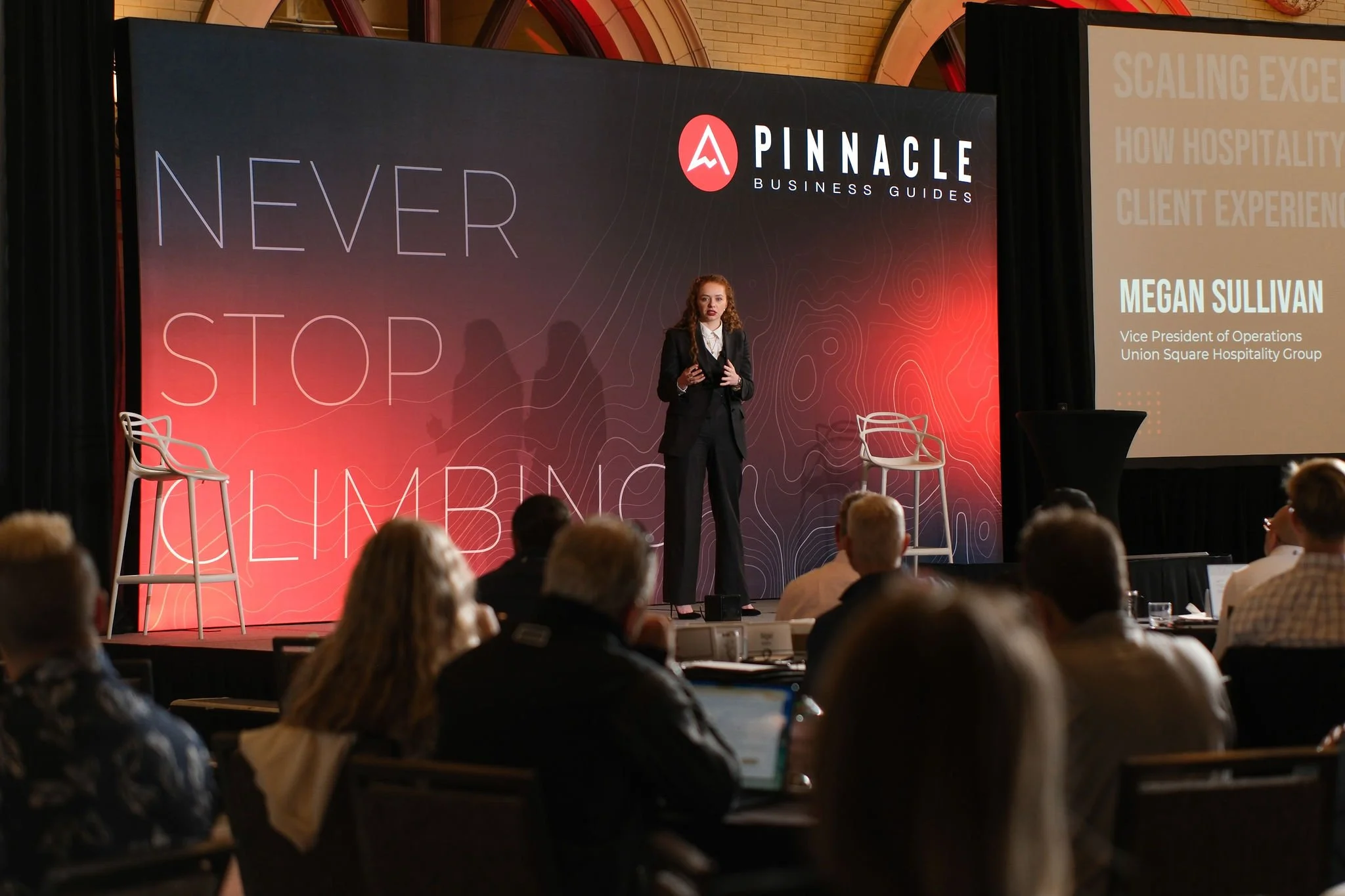
Megan Sullivan, VP of Operations at Union Square Hospitality Group
Start With Yes
I heard this story from Megan Sullivan, VP of Operations at Union Square Hospitality Group, at a recent Pinnacle Business Guides summit in Minneapolis. She shared it not as a feel-good anecdote but as a window into how they think and, more importantly, how they operate.
When that group walked in, the team didn't start with what wasn't possible. They started with yes.
They quickly assessed the situation. What did they have? What could they do? What would it take to turn this into something special rather than an embarrassing logistical failure?
Within minutes, they had a plan. They called their partner restaurant, Daily Provisions, just around the corner. They mobilized chefs and staff on short notice. They pulled together food that would be amazing but executable under pressure. They improvised a setup, had a speaker address the group from a bench, and created an evening that felt intentional rather than thrown together.
Most of the guests had no idea it wasn't supposed to happen this way. Many left thinking it was the best corporate dinner they'd ever attended.
How did they actually pull that magic off?
What Made "Start With Yes" Actually Possible
The mindset of starting with yes only works if the foundation underneath it is solid. This is where Megan's talk got really interesting to me.
The team moved that fast because of several things that had nothing to do with that specific moment:
They had the right people. People who understood the values, felt empowered to act on them, and didn't need to call a manager to get permission to do the right thing. When your people know what you stand for, they can make good decisions in situations you never anticipated.
They had built relationships. Daily Provisions wasn't a random vendor or space. It was a trusted partner in the same family of restaurants, with shared culture and shared standards.
They had operational playbook dialed in. They knew their inventory. They knew what they could execute well under pressure. They didn't have to guess or scramble for information. The foundation was stable enough take their playbook and apply it to the situation at hand.
They had a culture of generosity. As Megan put it: generosity is not a cost. It's a strategy. The team didn't stop to calculate whether this was worth it. They understood that going above and beyond in that moment would pay dividends they couldn't fully measure, in loyalty, in word of mouth, in the reputation of the brand.
Take any one of those four things away and the evening doesn't happen the same way.
That's the part that gets lost when people hear a story like this. They focus on the heroic improvisation. But the heroic improvisation was only possible because of everything that came before it. The people, relationships, operating foundation, and culture. That's what an operating system actually does when it's working, it builds the conditions where your people can be their best when the moment calls for it.
I've Been in That Moment
In March of 2020, I got my own version of 160 guests showing up a day early.
I was running Ally Pediatric Therapy. We had several clinics across Arizona and a team of more than 250 people delivering care to kids with autism and other developmental needs. In the span of about 48 hours, we had to shut down every clinic and figure out how to pivot to an entirely in-home therapy model.
There was no playbook for this. The situation was genuinely impossible by any reasonable standard.
One of our core values at Ally was "Be an Ally." Not just as a name, but as a real behavioral commitment to the families and staff who depended on us. When COVID hit and we knew almost nothing about the risks, many of our kids had co-occurring medical conditions that made the uncertainty even scarier. Being an ally to those families meant shutting down, even when it was hard, even when we didn't have all the answers, because we were not going to put kids at risk. That value guided the decision before anyone had time to overthink it.
But having the right values wasn't enough on its own. We needed great people who were willing to run toward the problem, and we needed an operating system that gave us the structure to move fast without falling apart. People drive performance, as Megan said. But people also need the right environment to perform in.
We started with yes. We figured out what we could do and acted on it. Over the course of a weekend, our therapists were in homes across Arizona, our kids were still receiving the care they needed, and our staff still had meaningful work to show up for. It wasn't perfect, but it was possible because we had the people, the values, and the operating foundation to make it happen.
Generosity Is a Strategy
One of my clients, Oberle Risk Strategies, is genuinely working to be a category of one in their market. That ambition shows up in how they operate internally, but it also shows up in how they treat the people around them.
Not long ago, I was scheduled to work with their team right around my birthday. I hadn't mentioned it. But somehow they found out. They called my spouse, asked what I liked, and learned that I have a soft spot for skillet cookies.
They showed up with homemade skillet cookies and ice cream.
Not a gift card. Not something grabbed from the grocery store on the way in. Something specific, personal, and clearly thought through. And I'll be honest, it made me feel genuinely seen and appreciated. Not like a vendor or a contractor passing through, but like someone they actually cared about. That feeling matters more than most people admit, and it has a way of deepening a relationship in ways that no contract or invoice ever could.
That is exactly what Megan means when she says generosity is not a cost. The return on that gesture isn't on a spreadsheet. It lives in the relationship, in the loyalty, in how people talk about you when you're not in the room.
The best businesses I've worked with understand this. They're not calculating every gesture against a budget. They've built a culture where thoughtfulness is just how things are done, and that culture was built intentionally, with the right values, the right people, and a system that reinforces both.
Every Day Is Opening Day
Megan closed her talk with a line that has stayed with me: every day is opening day. Every shift is the Super Bowl. Every client is Oprah.
It sounds intense. But the underlying idea is simple. Don't settle. Don't let the routine of operations flatten the experience you're delivering. The 160 guests at Ci Siamo didn't get a lesser evening because it was a Tuesday and the restaurant was already booked. The hospitality wasn't rationed based on the circumstances.
That standard, held every day, by every person, in every interaction, is what separates businesses that are good from businesses people actually remember and talk about.
It's not about perfection. It's about presence, care, and a refusal to phone it in. And it's worth asking honestly whether your team knows that's the standard, and whether your operating system is set up to reinforce it.
What This Means for Your Business
You might not be running a Michelin-starred restaurant. But you have your own version of 160 guests showing up a day early.
It's the client who calls on a Friday afternoon with an urgent problem. The employee who's struggling and needs someone to actually listen. The customer whose experience went sideways for reasons that weren't your fault but are now yours to own.
When that moment comes, and it will, what does your team reach for?
This is where an operating system earns its keep. Not in the planning meetings or the quarterly scorecards, but in those unscripted moments when someone on your team has to decide what kind of company you are. If your values are clear and lived, if your people are in the right seats and genuinely empowered, if you've built the operational foundation to move with confidence rather than scrambling for answers, your people can start with yes. They can be generous without asking permission. They can create something memorable out of something that could have been a disaster.
That's not a hospitality thing. That's a leadership thing. And it starts with the intentional work of building a company where the right thing happens automatically, even when no one's watching.
Further Reading
If this topic resonated, these books are worth your time:
Setting the Table by Danny Meyer. The foundational text on hospitality as a business philosophy. Meyer built Union Square Hospitality Group from the ground up and this book explains everything about how he thinks. Whether you're in restaurants or not, the principles translate.
Unreasonable Hospitality by Will Guidara. A compelling take on what happens when you give your team permission and resources to do something extraordinary for the people they serve. Guidara ran Eleven Madison Park, widely considered one of the best restaurants in the world, and the lessons here go well beyond fine dining.
Anthony Macleod is the Founder of Higher Peak and a Certified Pinnacle Business Guide. He's been in the seat, built and sold a multi-site healthcare company, and now helps other leaders do the same with intention. Reach out if you want to think through what this looks like in your business.